When a walker discovers a chick on the ground or in a nest, one question almost always comes up: what do baby birds eat? Behind this question lies a complex world shaped by the species, age, state of health, and the conditions in which the chick is growing. Whether in the wild or during a rescue, understanding what young birds eat helps maximize their chances of survival. This article explores every aspect of their diet, with surgical precision and a realistic look at common mistakes.
Each species has a different diet
Not all baby birds eat the same thing. Each species has its own needs. Passerines (sparrows, tits, robins) are fed insects, larvae, worms, or sometimes regurgitated food. Granivorous birds such as pigeons or doves digest seeds very poorly in their first days. They are fed “crop milk,” a rich substance produced by the parents. Birds of prey, on the other hand, consume small pieces of meat prepared by the adults.
Ignoring these differences exposes a chick to immediate danger. Giving bread to a baby blackbird worsens dehydration. Offering seeds to a swallow is a death sentence. You must adapt precisely to the species, even if that means contacting a wildlife rescue center to identify the chick.
A baby bird must eat very frequently in the first days
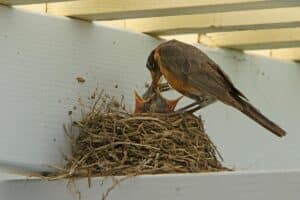
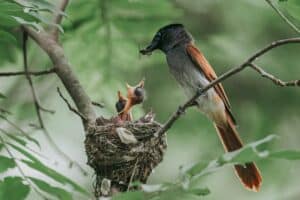
A baby bird eats very frequently, sometimes every 20 minutes depending on its age and species. At birth, its digestive system is still fragile. It can neither swallow solid foods nor digest processed products. Food is first placed directly into its wide-open beak, in small quantities.
Parents often make constant back-and-forth trips. They find live insects, crush them slightly or swallow them, then regurgitate them partially digested into the chick’s throat. This system allows for rapid assimilation without overloading the digestive system.
Consistency is key. Even a brief interruption in feeding leads to rapid weakening, especially if the chick has fallen from the nest. Its body temperature drops, its strength fades. Because digestion is closely linked to body heat, a chilled chick can no longer digest food.
What you must never give a baby bird
Faced with a chick, many people act with good intentions but inappropriate actions. Giving bread, milk, rusks, or crumbs remains a dramatic mistake. These foods swell in the stomach, cause fermentation, and block the digestive system. Milk, even plant-based, is never tolerated by birds. Unlike mammals, birds do not produce lactase, the enzyme that allows lactose digestion.
Another common mistake is giving water directly into the beak with a pipette or syringe. The risk of aspiration is high; water can enter the trachea and cause aspiration pneumonia. Rehydration must always be done through moist foods or specific solutions, carefully dosed and administered.
What baby birds fed by their parents eat in the wild
In the wild, parents choose prey of high nutritional quality. They catch:
Caterpillars
Flies
Small spiders
Beetles
Fragmented earthworms
Each mouthful is adapted to the chick’s age. In the first days, parents favor soft foods. Later, portion size increases and textures diversify, gradually preparing the young bird for a diet closer to that of adults.
Some birds, such as pigeons or flamingos, provide an internal substance called “milk” (different from mammalian milk), very rich in proteins and antibodies, secreted by their crop or throat. This secretion allows their young to survive even without external prey.
How to feed a baby bird that has fallen from the nest without making things worse
If the chick is naked or barely feathered, it cannot survive without help. Returning it to its nest is often the best option if the parents are still nearby. But if this is not possible, emergency feeding becomes necessary.
Here is what can be used temporarily to feed an insectivorous baby bird:
Cooked egg yolk, mashed
Cat kibble soaked and blended
Insectivore pâté (from pet stores)
Freeze-dried insects, rehydrated
Everything must be finely blended, warmed to room temperature (not hot), and administered using tweezers or a small stick. No syringe in the beak. Gently open the beak and place the food at the back, without forcing.
How often should a baby bird be fed depending on its age?
Feeding a chick is not only about the type of food, but also about frequency, which decreases with age:
Day 1 to 4: every 20 to 30 minutes, from 6 a.m. to 10 p.m.
Day 5 to 10: every 30 to 45 minutes
Day 11 to 20: every hour
After 3 weeks: every 2 to 3 hours
Feeding stops at night. Chicks sleep deeply, as if in a nest. No food should be given during nighttime rest, except in rescue cases under veterinary advice.
Appropriate foods depending on whether the chick is insectivorous, granivorous, or omnivorous
There are three major dietary categories among baby birds. Each requires a specific approach.
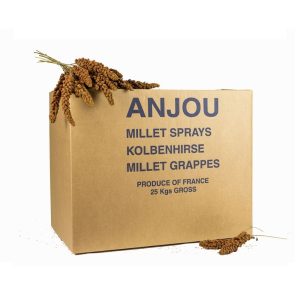
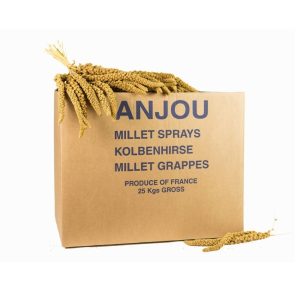
For granivorous birds, the gradual transition to seeds must be done with digestible, high-quality foods. Red millet provides an ideal base to support this transition. Its natural richness in nutrients promotes balanced growth while remaining suitable for the digestive system of young birds when they begin to peck on their own.
Red Millet for Chicks
A preferred feed for young seed-eating birds, rich in energy and suitable for breeding.
These are the most numerous in natural environments (tits, robins, swallows, swifts, etc.). They consume:
Live or freeze-dried insects
Insect-based mash
Protein-rich mixes without cereals
Goal: provide protein, moisture, and easy digestion.
Granivorous birds
Pigeons, doves, sparrows… Contrary to popular belief, seeds are introduced only later. At first, they are fed with “crop milk” or a lukewarm protein-rich mash.
A possible homemade preparation: water + corn flour + rearing mash + crushed hard-boiled egg. Blend everything and warm slightly.
Omnivorous birds
Blackbirds, starlings, magpies… They eat a bit of everything. You can offer them:
Insects
Ripe fruit (banana, peeled apple)
Omnivorous or insectivorous mash
Never give citrus fruits. Their acidity is poorly tolerated.
What does a baby bird eat when it starts feeding on its own?
From around 3 weeks of age, nestlings begin to peck on their own. Whole foods are gradually introduced: uncrushed insects, pieces of fruit, small soaked seeds. They should be encouraged toward independence, without forcing them. Placing a small dish with various accessible foods encourages experimentation.
When the young bird becomes more independent, offering easily digestible seeds such as yellow millet helps facilitate the learning process. This light seed, appreciated by many species, promotes autonomy and helps young birds develop pecking behavior similar to what they would encounter in the wild.
Some birds, such as swallows or swifts, will never feed on their own. They must be released as soon as they are able to fly, as their food source (flying insects) cannot be captured in captivity.
Yellow Millet for Chicks
Fine and easily digestible seed, perfect for helping young birds transition toward independence.
What to feed a baby swift, a species that eats only while flying?
The common swift never lands on the ground, except in the event of an accident. It lives almost permanently in flight. Its diet is therefore exclusively aerial. In captivity, it must be hand-fed several times a day, using only suitable insects (crickets, fruit flies, chopped mealworms).
It is one of the most difficult species to feed. A dietary mistake or a release that is too late can be fatal. Release must take place before 45 days, otherwise there is a risk of long-term loss of flying ability.
A baby bird does not drink; it hydrates only through food
Baby birds do not drink like adults. They hydrate through their food. This is why moist, rehydrated, or water-cooked foods must be used. Never dry or raw foods. A mixture that is too thick tires the chick. Too liquid, and it can enter the respiratory tract.
In cases of confirmed dehydration, an emergency mixture can be prepared:
1/2 liter of water
1 tablespoon of sugar
A pinch of salt
To be administered drop by drop at the edge of the beak. Never directly into the throat.
Observing droppings to know whether a chick’s diet is suitable
A reliable indicator is the quality of the droppings. If they are liquid, greenish, or sticky, the diet is not appropriate. Firm, white, well-formed droppings indicate a properly functioning digestive system. When in doubt, it is best to stop feeding, keep the chick warm, and consult a professional.