
A puppy that vomits its kibble is always worrying. We immediately think of illness, a veterinary emergency, or even a food allergy. Yet in many cases, the causes are far more ordinary than they seem. The goal here is simple: answer clearly all the questions that arise when faced with this type of vomiting. Understand the causes. Identify the right reflexes. And above all, act appropriately, without giving in to panic.
Regurgitation or true vomiting: how to tell the difference in a puppy
When a puppy vomits its kibble, it is not always true vomiting. It may be regurgitation. The distinction is critical. Vomiting is an active process, involving abdominal contractions. The puppy shows signs beforehand, salivates, then expels the stomach contents. Regurgitation, on the other hand, is passive. It happens without effort, often shortly after eating.
The expelled material provides an important clue: if it is undigested, shaped like intact kibble, it is likely regurgitation. If it is partially digested and mixed with bile, it is vomiting. This detail guides the entire analysis, because the causes differ, and so do the solutions.
My puppy vomits its kibble right after eating: is it eating too fast?
Young dogs are often greedy. They devour their meal in just a few seconds. As a result, the kibble swells in the stomach, digestion struggles to keep up, and the excess comes back up. Most of the time, the puppy feels fine. It keeps playing and asks for food again as if nothing happened.
This situation is not harmless, though. Repeating this pattern can irritate the esophagus and encourage chronic issues. Several simple solutions exist: divide the daily ration into smaller portions, use a slow-feeder bowl, or moisten the kibble so it swells before ingestion. The effect is immediate: easier digestion and less strain on the stomach.
Vomiting after a change in kibble: what you did wrong
Changing a puppy’s food without a transition often causes digestive upset. The kibble composition changes. Proteins, fats, fibers, everything shifts. The digestive tract, still immature, cannot adapt that quickly. The result: the puppy vomits its kibble, sometimes after just a few bites.
The rule is simple: introduce the new food gradually over one week. Start with 25% new kibble for the first two days, then 50%, 75%, and finally 100%. At the same time, monitor stools, appetite, and overall behavior. A transition that is too abrupt can disrupt the entire digestive ecosystem.
Inappropriate kibble: a common cause of vomiting in young dogs
Feeding adult dog kibble to a puppy often leads to digestive reactions. Puppies have specific needs. Their stomachs are smaller, their intestinal flora more fragile. Puppy kibble is formulated with more digestible proteins, precise nutrients for growth, and a texture suited to their jaw.
If the kibble is too hard or poorly sized, the puppy does not chew properly. It swallows large pieces. The stomach works harder, and rejection becomes likely. This is not an allergy, but a poor dietary choice. The solution is to choose premium puppy kibble adapted to the puppy’s breed, age, and size.
Cold or overly soaked kibble can make a puppy vomit

Few owners think about it, yet giving cold or overly soaked kibble, especially straight from the refrigerator or after prolonged soaking in water, can upset the stomach. The temperature difference can trigger a gastric spasm, particularly in sensitive puppies. The result: the puppy vomits its kibble shortly after the meal.
You should serve food at room temperature. If the kibble has been rehydrated, wait at least 15 minutes before offering it. This avoids digestive shock and can be enough to stop the vomiting altogether.
Digestive worms can explain why your puppy vomits its kibble
A puppy infested with worms often has an irregular appetite. Sometimes it eats voraciously, sometimes it refuses food. Vomiting is common, often accompanied by soft stools, a bloated belly, or flatulence. Some worms may even be visible in the vomit or stools.
The solution allows no delay: an appropriate dewormer, prescribed by a veterinarian. Not a random over-the-counter product. It must also be given at precise intervals, usually every two weeks until three months of age, then monthly until six months. Without this protocol, reinfestation is very likely.
Food intolerance or allergy: a possibility not to dismiss too quickly
Much rarer in puppies than in adult dogs, food allergies are still possible. Some puppies react to a specific protein source: chicken, beef, or even fish. Symptoms include vomiting, itching, and redness around the mouth or ears.
Diagnosis is never straightforward. It requires a strict elimination diet, under veterinary supervision. All suspected sources are removed, and a hydrolyzed protein or hypoallergenic diet is introduced. A return to normal digestion can take several weeks.
Repeated vomiting: when should you worry about a more serious problem?
Some puppies suffer from congenital megaesophagus. The esophagus is dilated and unable to move food down properly. Kibble remains stuck and is regurgitated intact. The puppy keeps its appetite but loses weight. Vomiting occurs daily, always shortly after meals.
There are also infectious causes: parvovirus, canine coronavirus, or gastritis. In these cases, vomiting is accompanied by marked fatigue, refusal to eat, and sometimes bloody diarrhea. Emergency veterinary care is required.
The veterinarian may prescribe additional tests: X-rays, ultrasound, blood work. If a malformation is identified, solutions exist. Feeding posture can be adapted by raising the bowl, food texture can be modified, or surgery may be considered when justified.
Puppy vomiting kibble: warning signs that require rapid action

Some symptoms associated with vomiting require immediate veterinary consultation. The most concerning include:
- Very frequent vomiting, projectile vomiting, with bile or blood.
- Lethargy, refusal to eat, rapid weight loss.
- A hard abdomen that is painful to the touch.
- Severe diarrhea, black or bloody stools.
- Fever or unusual apathy.
In these situations, you should not “wait and see.” Every hour counts, especially in a puppy. Dehydration sets in quickly, and prognosis often depends on how fast action is taken.
Puppy vomiting: common mistakes to absolutely avoid
When faced with a puppy that vomits its kibble, some reactions make the situation worse. Giving milk. Changing kibble every two days. Withholding food for 24 hours without medical advice. Or using medication intended for humans. These actions are counterproductive and sometimes dangerous.
It is far better to note the timing of vomiting episodes, observe texture, frequency, and the puppy’s overall attitude, then contact your veterinarian with precise information. These details help guide diagnosis and enable targeted treatment.
Adjusting the environment and meals to prevent vomiting in puppies
Sometimes the solution lies in simple adjustments. Reduce sources of stress. Avoid intense play immediately after meals. Space out feedings. Remove chew toys lying around, as some puppies swallow pieces of plastic or fabric, which can trigger reflex vomiting.
Observing the puppy during meals often provides clues. If it eats with its head down, without chewing, in a noisy or chaotic area, recurrent digestive issues are more likely. Returning to a calm feeding environment often makes a noticeable difference.
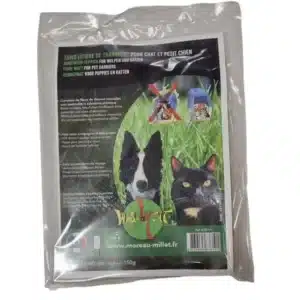
Adapting the environment also involves the choice of surfaces the puppy moves on. A puppy stressed by strong odors or uncomfortable flooring may alter its behavior, including at mealtime. During transport or training periods, it can be helpful to use a natural fiber mat, such as a transport litter mat for cats and small dogs. This type of biodegradable hemp mat, free from pesticides and additives, provides absorbent comfort, limits disturbances, and helps create a more stable environment for a young animal. Several sizes are available, depending on the puppy’s size or intended use.