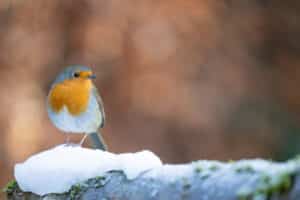
During a walk in woodland or along a garden hedge, a small flash of reddish feathers may sometimes catch the eye. The robin is there, discreet but attentive, often perched close to its territory. This small bird, with its clear and melodious song, hides a complex world. Its nest, a true masterpiece of camouflage and strategy, often escapes notice. Yet understanding where and how a robin’s nest in the wild is formed not only helps us learn more about the species, but also allows better coexistence with it, without disturbing its balance.
How a robin’s nest is built in the wild
The robin’s nest does not look like much. It seems made of almost nothing, and yet everything is carefully thought out. The female alone builds this rounded structure, lined with dry leaves, grasses, moss, hair, and sometimes feathers left behind by other birds. Everything is carefully interwoven. The result is a shelter that is solid, flexible, and insulating. It is not uncommon for a nest to measure around ten centimeters in diameter. The interior, narrower, perfectly fits the body of the brooding female.
This structure blends into its surroundings. At the foot of a tree, in a hollow in the ground, among roots, under an old woodpile, or in a corner of a dense hedge, it can be almost invisible. Nothing sticks out. Nothing shines. The camouflage is total. It is a matter of survival. In the wild, predators are numerous. A nest that is too exposed means a lost brood.
Where the robin’s nest hides in the wild
The robin’s territory is not chosen at random. The bird is sedentary and carefully selects its living area. In gardens, dense hedges, old hollow walls, stacks of logs, stumps, or even an abandoned planter can serve as shelter. In France, nests can be found in almost all regions, from the countryside to the heart of cities, as long as there is a minimum of vegetation and quiet corners.
In the wild, the robin favors humid, wooded areas rich in insects and little disturbed by humans. The nesting season begins early, sometimes as soon as the end of winter, which pushes the species to establish its nest quickly, before other birds settle nearby.
For example, a nest may be observed hidden beneath a partially buried stump or within a very dense bush. One often needs to approach quietly, take time, observe the bird’s comings and goings, and guess the entrance to a tiny world.
When and how the robin builds its nest in the wild
The nesting period begins in March, sometimes at the end of February in mild regions. It can extend until July, or even August. The female generally lays between 5 and 7 eggs, white speckled with red or light brown. One clutch lasts about two weeks. During this time, the female stays in the nest, while the male watches over the surroundings.
The chicks are born naked, blind, and completely dependent. They grow quickly. Within two weeks, they leave the nest, still clumsy but already lively. It is not uncommon for a pair to produce two broods in the same season, sometimes three if conditions are favorable.
This sustained rhythm helps compensate for losses. Because the life of the robin, like that of all wild birds, remains fragile. Between domestic cats, corvids, snakes, bad weather, and humans, few nests make it to the end.
The role of the robin’s nest in the wild
The robin plays a key role in local biodiversity. By consuming insects, larvae, and worms, it helps regulate populations. When it nests in a garden, it brings a valuable balance, sometimes more effective than chemical treatments.
Its nest, often reused by other species (shrews, rodents, butterflies…), also becomes part of the ecological chain. As it decomposes, it enriches the soil. It promotes the dispersion of plant fragments, seeds, or spores. Each nest tells a micro-story of nature, where the bird, the soil, the season, and the territory interact.
Preserving a nest is not only about protecting a robin; it is about maintaining a living network around it. And this network, very often, also works in favor of humans, making gardens more vibrant, more fertile, and more sustainable.
If you wish to support their presence while respecting their natural behavior, a balanced mix of seeds and insects can be placed at a distance from the nest to feed the adults during the breeding period.
Seed and Insect Mix
Support robins during the nesting season with this blend.
How to observe a robin’s nest in the wild without disturbing it
Have you noticed a robin repeatedly disappearing in the same direction? There may be a nest nearby. Above all, be patient. Observation requires calm. Avoid sudden movements and loud noises. Do not approach the nest directly. Keep your distance. Use binoculars if necessary.
The bird does not tolerate repeated disturbances well. Excessive stress can lead to abandonment of the clutch. Even during casual walks, limit intrusions into areas where you suspect nests may be present.
Never touch the nest or its surroundings. Even a slight change to the environment can make it too visible to predators. If you have a garden, avoid trimming hedges during the breeding season. Keep cats indoors, at least for part of the day. Every action counts.
Can a natural robin’s nest be replaced with a nest box in your garden?
In some cases, it is possible to help the robin by installing a suitable nest box. Unlike other species, this small bird does not seek an enclosed cavity. It prefers a semi-open shelter, shaped like a half-box, placed at a low height (between 1 m and 1.5 m), hidden in a bush or against a wall covered with vegetation.
The goal is not to replace nature, but to offer a fallback solution where hedges, stumps, and natural nooks have disappeared. This type of nest box can encourage a pair to settle, especially during colder seasons when natural sites become scarce.
However, installing a nest box requires care. It must be discreet, sheltered from prevailing winds, and out of reach of predators. It should be cleaned at the end of summer, but never during the nesting period.
For those who wish to go a step further, it is possible to hang a small net of natural cotton in the garden: the robin will collect material from it to reinforce its nest, especially if natural resources are scarce early in the season.
Why the robin’s nest in the wild deserves to be observed and protected
The robin’s nest in the wild is more than just a shelter. It reflects a discreet way of life, deeply rooted in our landscapes. By learning about it and respecting it, we learn to live withnature, not against it. Observing these small birds, quietly and without impact, changes the way we look at a garden, a hedge, or an old stone wall.
Each nest is a starting point. It invites us to slow down, to listen, to learn. It connects us, silently, to the living world. And within that connection lies a promise: to give every patch of land the place it deserves in the great story of life.