When a cat ignores a brand-new scratching post, many owners feel helpless. Yet one simple solution can make all the difference: catnip. This plant, with its remarkable properties, irresistibly attracts many felines. Its scent acts on their sensory system, triggering natural behaviors such as rubbing, rolling, or scratching. To turn a scratching post into a valued territory, catnip can be an excellent trigger. Still, it must be used correctly, depending on its form and the type of scratching post. Here is a precise method, enriched with practical advice and tested alternatives, to stimulate your four-legged companion’s interest.
Why catnip helps your cat use a scratching post
Catnip, also known as Nepeta cataria, causes strong sensory stimulation in around 7 out of 10 cats. Its active compound, nepetalactone, mimics certain substances found in feline pheromones. This can prompt the animal to rub, roll, lick, and then scratch, in a brief and harmless state of excitement.
Using this natural reaction on a scratching post helps associate the object with a positive experience. As a result, the cat identifies it as an appealing outlet for releasing energy. This reduces the likelihood of turning to furniture, rugs, or sofas. This simple conditioning can be enough to establish a good habit.
The effect varies depending on the individual cat and the freshness of the product. That is why it is important to adapt the form of catnip used to the goal and the type of scratching surface.
Which forms of catnip to use to stimulate a scratching post
Catnip comes in several forms. Each version is used differently on a scratching post. Here is how to distinguish them and apply them effectively.
Sprinkling catnip powder on a scratching post
The most direct form is dried catnip powder. It allows natural diffusion of aromas as soon as it is crumbled onto the scratching surface. Simply sprinkle a small pinch in strategic areas: where the cat places its paws or at the center of the scratching zone.
This format offers several advantages: it is easy to measure, inexpensive, and immediately effective if the product is of good quality. It can also be lightly rubbed in to impregnate the fibers of the surface. Ideal for horizontal cardboard scratchers or sisal mats.
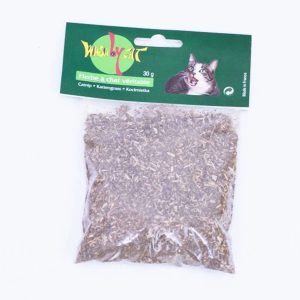
True Catnip – 30 g Sachet
An intense, natural scent to instantly stimulate your cat’s scratching instinct.
Sprays based on nepetalactone allow for clean, targeted application without visible residue. They are suitable for fabric or vertical surfaces, such as sisal rope scratching posts. The user can lightly spray the desired area, then let it dry for a few moments before presenting the scratching post to the cat.
This format is practical for those who do not want to handle powder or prefer to limit visible marks. However, effectiveness depends on the product’s concentration, and some cats respond less to it.
Using a fresh catnip plant to attract a cat
Growing Nepeta at home or buying a pot of fresh catnip can also be effective. In this case, the leaves can be rubbed directly onto the scratching post to transfer the scent. This method works well for cats that respond strongly to fresh volatile oils but less to dried powder.
It is a more natural approach, which also contributes to environmental enrichment for the cat. However, it requires a bit more maintenance.
Steps to properly apply catnip to a scratching post
Before applying anything, make sure the scratching post is clean, not saturated with foreign odors, and well positioned in the cat’s living space. Then, you can choose the appropriate method:
Powder: sprinkle a small amount (1/4 teaspoon) on the areas where the cat places its paws, then rub lightly if needed.
Spray: spray from 10 cm away from the surface, wait 1 minute, then offer it to the cat.
Fresh leaves: rub the stems against the fibers of the scratching post.
Valerian: place the core nearby or rub it on the surface, then remove it after use.
It is recommended to repeat the application once or twice a week. Applying it too frequently can desensitize the animal. The best approach is to observe reactions and adjust the frequency accordingly.
Finally, for vertical or wall-mounted scratching posts, it is best to apply the product higher up, at the cat’s shoulder height, to encourage it to stand and stretch.
Mistakes that prevent catnip from working on a scratching post
Even when following the correct method, certain habits can compromise the effectiveness of catnip. The first pitfall is applying it too often. When used daily, the stimulation decreases. The cat becomes accustomed to the scent and stops reacting. It is better to space applications several days apart, or even a week, to preserve curiosity.
Another common mistake is using expired or poorly stored catnip. The active compounds evaporate over time. The product should therefore be kept in an airtight container, away from heat and light. If the powder has lost its scent, it will be ineffective, even in large quantities.
The scratching post itself can also be an issue. A post that is too worn, dirty, or poorly positioned does not encourage use. Ideally, it should be stable, located in a passageway, and large enough to allow the animal to stretch its body fully.
Finally, some owners apply catnip next to the scratching post or on a nearby mat. The result is that the cat plays in that area but ignores the intended surface. It is essential to target the scratching surface itself and not to spread it randomly in the environment.
What to do if catnip does not work on your scratching post
Around 30% to 50% of cats do not react to nepetalactone, and this does not indicate a problem. This lack of response can be genetic. In kittens, sensitivity often develops only after the age of 6 months. In others, it remains absent throughout their life.
In such cases, several alternatives can be tested:
Valerian often triggers a strong reaction.
Fresh catnip, sometimes more effective than the dried form.
Actinidia polygama, also known as matatabi or silvervine, which is highly appreciated by Asian or older cats.
Valerian Root for Cats
Stimulates play and scratching instincts thanks to the natural euphoric effect of valerian.
It is also possible to stimulate interest in other ways, by temporarily placing a toy, a treat, or a cushion in the scratching post area. The goal remains the same: to create a positive association. If the cat gradually adopts the scratching post for play or relaxation, the need to scratch will eventually develop naturally.
Finally, it is important to remember that cats need several scratching posts. Some prefer inclined surfaces, others vertical supports. Varying materials and locations increases the chances of success, with or without catnip.